
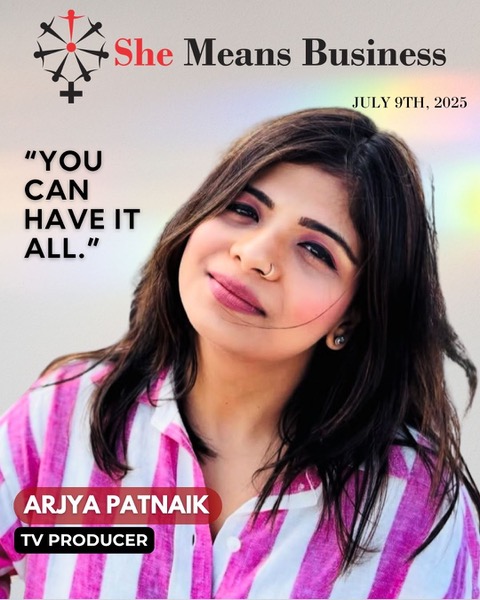
You can have it all.
Arjya Patnaik never expected her life to shift so suddenly. One day, she was the daughter of
a well-known filmmaker, living with the comfort and the scrutiny that came with his name. To
many, she was simply a “nepokid,” and while the label didn’t bother her too much at first,
everything changed when her father was diagnosed with cancer.
“That’s when everything flipped,” she later said. At just 20, Arjya was forced to step into a
role she hadn’t prepared for. With little time to grieve or process, she became the son of the
house. The experience changed her. It taught her how fragile life could be, and it gave her a
deep sense of urgency. “I realised life is short. I should do something meaningful with mine.”
By 26, she was offered an unexpected opportunity: to lead Zee’s new Odia channel as its
channel head. It was a huge step and a bold one. She was younger than everyone on her
team, many of whom were twice her age and predominantly male. Scepticism came swiftly.
She wasn’t taken seriously. She was judged for her age, her gender, and her lifestyle.
People whispered about her being unmarried, calling her too modern and too outspoken.
Some even labeled her a “bitch.”
At first, the criticism cut deep. She tried to change herself—putting on weight in the hope that
looking older might earn her respect. But eventually, she came to a powerful realisation: the
problem wasn’t her. It was them.
Arjya turned her focus to what she was there to do: build something great. And she did just
that. Under her leadership, the channel rose to the number one position in Odisha and
continues to hold that spot to this day.
Though she had begun her career as a journalism intern at CNN, Arjya discovered early on
that it wasn’t the news that excited her but it was storytelling. “I love stories. Always have.
Our mom, Our Grandma—they told us so many growing up. Those stories stay with you,
don’t they?” she said.
Now, she tells stories through television, but with clear intention and purpose. A proud
feminist, Arjya is determined to create narratives where women do more than suffer or
sacrifice. She wants to show them dreaming, building, and changing the world. One of her
proudest creations is Barrister Babu: a show about a woman who becomes a lawyer after
marriage. “If that show made even one woman feel like she could go after what she wanted,
I’ve done something right,” she said.
Despite her accomplishments, Arjya battled with self-worth for much of her life. She found it
hard to accept compliments, often compared her work to others, and struggled with imposter
syndrome. “I didn’t think I was beautiful. My writing, my work—it was never good enough in
my head,” she admitted.
The turning point came when she reframed that doubt: Mediocre people don’t feel this way.
She told herself that the fact that she questioned herself meant she was actually doing
something meaningful. From that point on, whenever the inner critic returned, she responded
with action. “Start anyway. Do the work. Even if it’s not perfect. Perfection is the biggest
scam.”
In a bold move, she stepped away from her job and launched her own production house,
pouring in her time, money, and heart. But her first show under the new banner lasted only
50 episodes before being shut down. It was a crushing blow. “I was shattered. Everything I
had saved was gone. I lost all motivation. I didn’t want to get out of bed,” she recalled.
It was her mentor who pulled her back from the edge, reminding her of her worth and
reigniting her confidence. Slowly, new doors opened. One of them led to Savdhaan India,
which went on to run for two successful seasons under her direction.
“That failure humbled me. It showed me what not to do. It made me stronger,” Arjya said.
More importantly, it taught her that setbacks don’t define a person how they respond to them
does. “Now, no external situation can shake my mental health. I’m not attached to success. I
know it comes and goes.”
As a hyperindependent woman, Arjya often felt like she had to choose career or love, family
or ambition. But she’s done trying to follow that script.
“It’s all in your head,” she says. “You don’t have to give up one thing to have the other. You
can have it all. You don’t need to compromise before


