
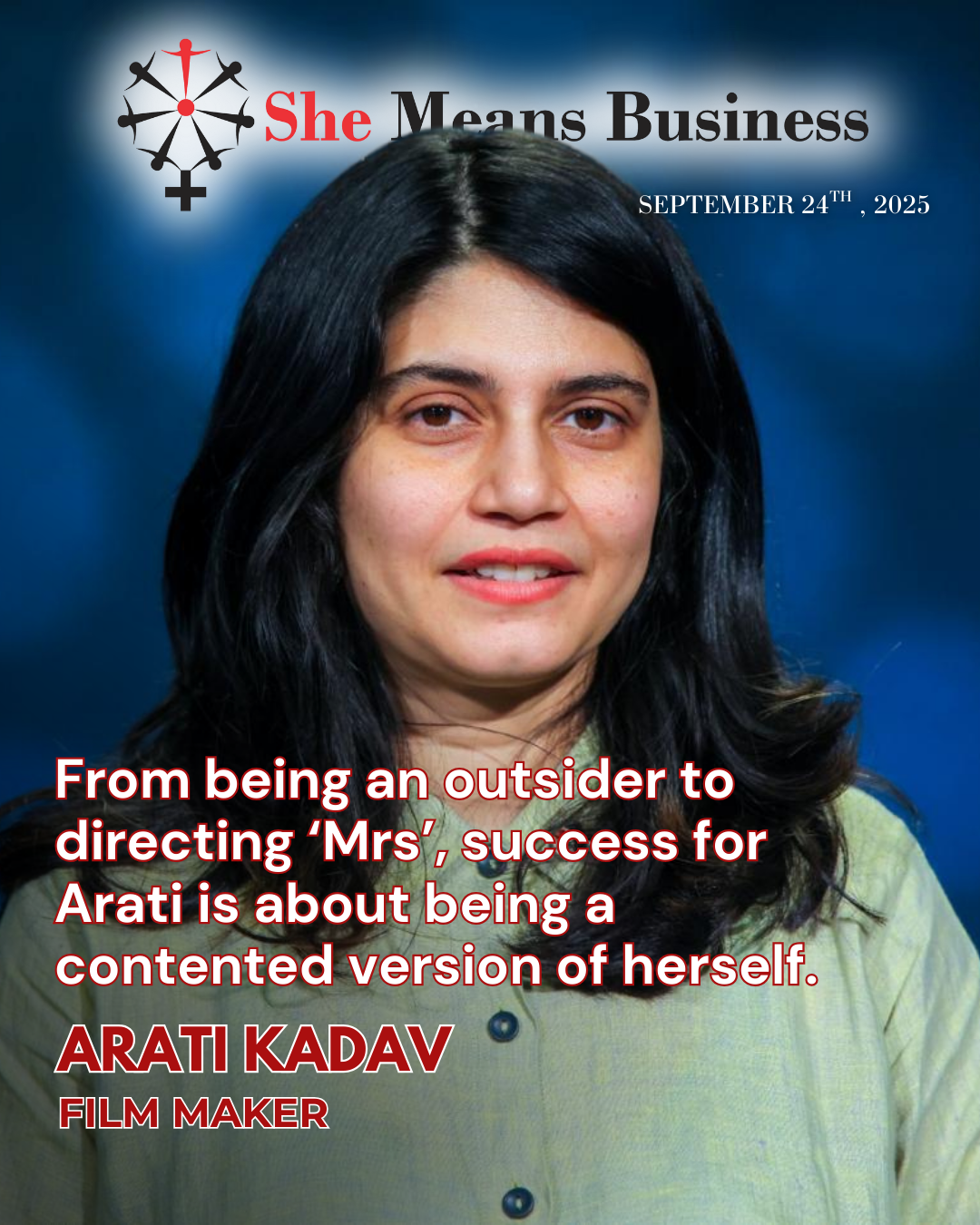
For Arati Kadav, filmmaking has never been just about the camera or the script; it’s about
consistency, preparation, and staying true to her core values. “One can be brilliant, but one has
to be vigilant about one’s values,” she says.
“If I am not prepared, I won’t even do the meeting.
Preparing hard is the biggest investment I’ve made in myself.”
Breaking into the film industry as an outsider wasn’t easy. Ten years ago, long before OTT
platforms opened doors for emerging filmmakers, Arati began by making short films and
submitting them to festivals. She even worked with established actors like Jackie Shroff for her
projects. “You can’t just say you make movies, you have to show it,” she recalls. For her,
storytelling went beyond spoken language. It was about sparking fascination, about showing
passion rather than talking about it.
Her first feature, Cargo, starring Vikrant Massey, was both a dream and a test. “I remember
wondering if I was in the right place. Imposter syndrome keeps lurking, but I prepare hard. I
want to be the most prepared person in the room, that’s the only way I know to get over it.”
The industry, she admits, is tough.
There are dizzying highs and crushing lows. Some early
projects she poured her heart into didn’t work out. “I worked on a script for more than a year,
and when it didn’t happen, I felt shattered. But talking to co-directors, I realised, everyone goes
through this trajectory. You can’t take failure so personally.”
Arati’s discipline keeps her steady. She structures her weeks, sets priorities, and rarely
compromises on her writing hours. “I rarely go for night outs. I wake up early, so I have to sleep
early, otherwise my morning writing goes to waste. Planning and compartmentalising help me
give time to my family too.”
Being underestimated, she says, is part and parcel of being a woman in the industry. “Gender
colours the way people see you. Once, when I was thinking out loud, I could sense a junior
doubting whether I was good enough. It’s okay to be vulnerable, but you must assert yourself. If
you work hard, you have the right to debate. Don’t carry self-doubt into the next day; be
assertive, go back with confidence. And sometimes, you just have to be a little deaf.”
Her lowest point came after what she calls her “biggest failure.” She had given years of work to
a film that didn’t land, all while caring for a one-year-old baby. “I hit rock bottom. I wondered,
where do I start again?” Instead of breaking down, she produced her own first film. “The path
was tough, but the personal growth was insane. I became wiser, more patient. Filmmakers learn
the most when they make their own films.”
Today, success for Arati is not about shiny premieres or fleeting applause. “Success is being a
contented version of yourself, in your life, at peace with yourself. The shiny things pass fast.”
Her advice to young dreamers is simple, almost poetic: “Just work with enthusiasm. Take the
leap. If you have that mad drive, roads will come your way, paths will open. That’s the magic of
it.
When Arati Kadav’s film Mrs. was released, she braced herself for the worst. “There were six
releases scheduled that week. I was sceptical, so worried, will people even watch Mrs.?” she
recalls. Her team reassured her: OTT viewership doesn’t always spike on day one. Sometimes
responses come on day four. But Arati couldn’t shake the fear.
That fear, however, was short-lived. The very morning after the release, her notifications blew
up. “I woke up to so many reels, tagged on so many posts. Sanya Malhotra told me she couldn’t
even open her social media because she was flooded with hundreds of messages. She said, I
feel like we are hugged by the Universe. That was exactly how it felt surreal.”
For Arati, the success of Mrs. wasn’t about numbers but about resonance. Strangers,
neighbours, and even acquaintances she rarely spoke to poured their hearts out after watching
the film. “People in my society, whom I had barely exchanged hellos with, suddenly spoke to me
for 45 minutes, like I was their therapist. They told me how much the film resonated with them.
That’s when I realised, we had started a dialogue.”
The dialogue was necessary, and sometimes painful. During a trip abroad, she met a woman
whose husband casually asked, ‘Itna bhi kya kiya jo itna gussa ho gayi?’ What did he really do
to be so angry? “And these were educated, well-travelled, well-exposed people,” Arati says. “If
this is the mindset in cities, imagine rural India.”
That’s why, for her, films like Mrs. matter. They nudge society, challenge old conditioning, and
open new conversations. “Bollywood is changing. The characters are changing. Empowered
women don’t have to look a certain way. They don’t need to smoke, or drink, or be arrogant, or
fight all the time. Empowerment is layered women can be strong and soft, glamorous and
grounded, complex and real.”
For Arati, filmmaking is not about shouting to be heard, but about telling stories that shift
perspectives. Mrs. was made with “utmost honesty and purity,” as she puts it. Its reception has
left her both grateful and humbled. “I didn’t expect anything. And yet, the film gave us everything
not just views, but conversations. That’s when you know a story has done its job.”


